

2–3
trades a week
on average — quality over volume
$25k
sizing basis
posted sizes scale to your account
1–2h
execution window
no screen-watching required
A week of alerts, as it happens
New trade, adjustment, market update, close — this is the rhythm of a typical week in your inbox.
Every stage of the trade, in your inbox
-
New trades
The full order: instrument, size, entry price, stop.
-
Adjustments
When a stop tightens or a position changes, you hear it first.
-
Closing alerts
Every trade is closed out loud — winners and losers alike.
-
Market updates
Context on the VIX picture between trades, so alerts never arrive cold.
Fade Volatility Alerts
to me · today, 10:42 AM
New trade — Mini VIX futures
Sell to open 1 contract VXMQ26 (Mini VIX futures, Aug expiration) at 19.20 or better.
If it fills, add a stop limit: 23.00 stop / 23.50 limit, good till canceled.
No rush — executing within an hour or two is typically fine. The 19.20 target tells you whether the market has already moved too far.
Why it works
Volatility spikes fast and fades slow — it mean-reverts on a measurable curve. The chart below shows 4,400+ VIX futures observations since 2008: at every opening price level, the median 2-month forward return is negative. Higher VIX means deeper fade.
"This graphic captures the phenomenon that Thomas and I sometimes refer to as the tailwind — the structural mean-reversion tendency behind the many more specific trades we actually produce."
The chart doesn't tell you when to trade — that's what the alerts are for. What it shows is that the broad current runs in our favor: at historically elevated VIX levels, the market has a measurable tendency to fade. Every trade we issue is a more precise, timed expression of the same edge this data describes.
The member portal
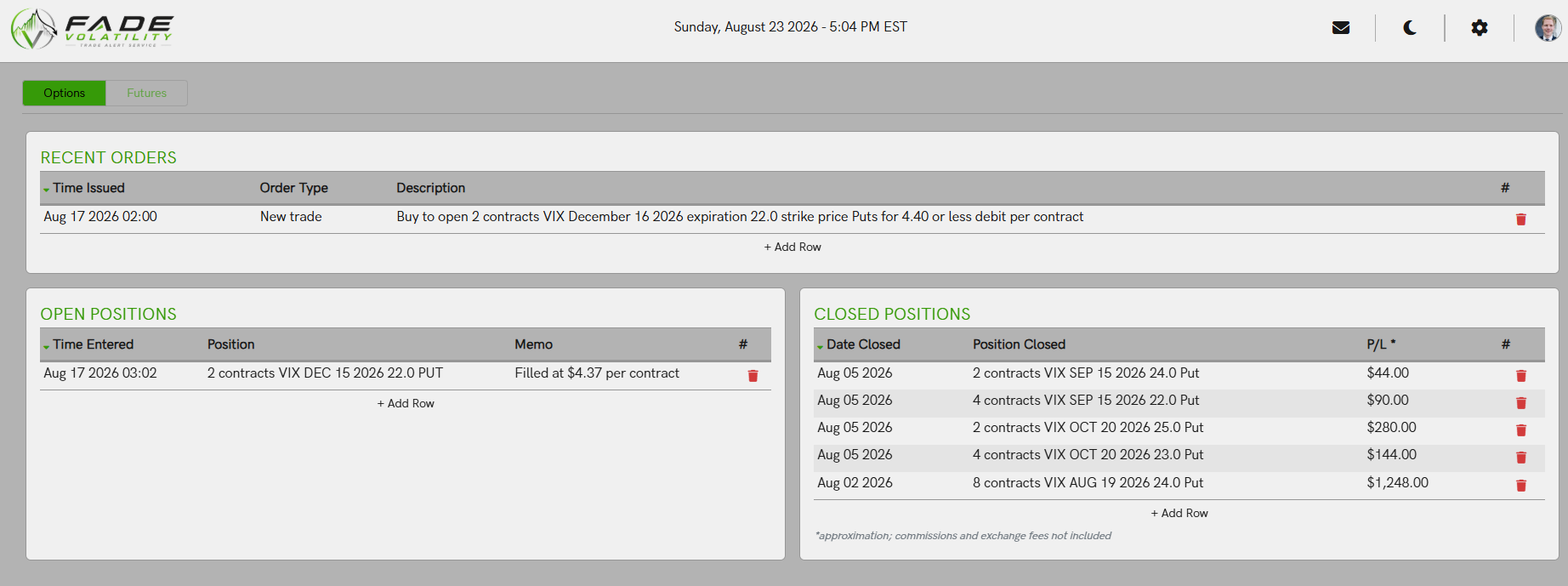
Alerts arrive by email; the portal keeps the full record — market updates, the complete history of every alert, open trades, and closed positions. Always current.
The people behind the trades

Brandon Buerge
Founder & Lead Trader
Dr. Brandon Buerge is a practicing aerodynamicist at the National Institute for Aviation Research, with twenty years of experience in quantitative problem-solving. He built Fade Volatility by applying an engineer's rigor to market structure — identifying measurable edge in VIX mean-reversion and designing probability-based strategies around it. He resides with his wife and four children in Wichita, KS.

Thomas Doylend
Co-founder & Technology
Thomas Doylend writes trading software at Microflight, testing new algorithms and designing execution engines. He brings the same analytical delight in puzzles and mathematics to strategy research at Fade Volatility, and built the member portal that keeps every subscriber current between alerts. He lives with his wife and baby in Lincoln, Nebraska.
Pricing
Subscriptions renew until canceled. Cancel anytime — checkout is handled securely by Spiffy.
Premium Bundle
Best valueOptions and Futures — both alert streams
Common questions
How fast do I need to act on an alert?
There is a timing component, but you don't need to sit in front of a screen. Executing with a 1–2 hour delay is typically fine, and every alert includes a target entry price so you can judge whether the trade still makes sense or the market has already moved too far.
How is position size determined?
All posted trade sizes assume a $20,000 trading account. Scale the posted size up or down to match your own account.
How often are alerts posted?
It depends on market conditions. On average, expect 2–3 trades per week.